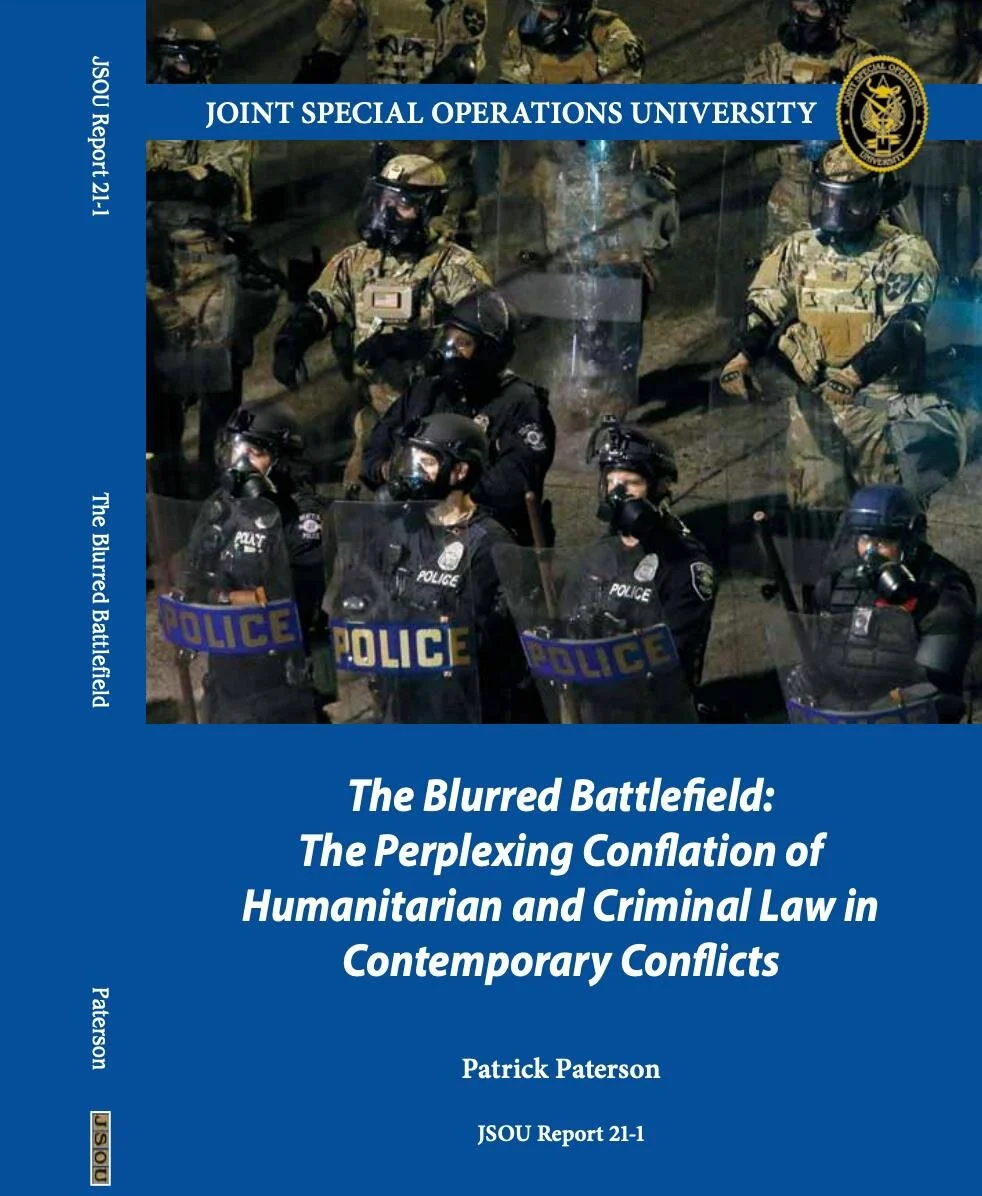

Last week I traveled to Colombia to conduct research for my upcoming book. The book will address how contemporary warfare requires simultaneous application of the laws of armed conflict (LOAC), criminal law, and human rights (HR) law – complex concepts with which many governments are currently struggling, including our own.
The purpose of my visit was to understand how the Colombian military conducts training for operations against irregular or guerrilla forces within their country, including the FARC, ELN, and BACRIM. The fight against cartels and gangs has forced many Latin American governments to deploy their militaries internally to support or entirely replace the police. These battles fall into a lower category of conflict in which the Geneva Conventions and LOAC no longer apply.

This situation is increasingly common. In fact, more than 80 percent of countries in the world are not engaged in nation-to-nation conflicts, but in conflicts that are between governments and irregular forces; as such, these conflicts are not covered by LOAC. Colombia, currently working to contain five internal organized armed groups (OAG), is handling this problem by applying a hybrid solution. This is a unique solution, and Colombia offers a helpful example as a possible way forward for other governments struggling to handle this new type of warfare.
During my trip, I conducted interviews with U.S. embassy security cooperation officials, US SOF personnel, senior Colombian military (COLMIL) officers, COLMIL lawyers, academics, and the International Committee of the Red Cross (ICRC) delegation in Colombia. At the invitation of the Colombian military, I also visited their National Training Center in Tolemaida, about 3 hours south of the capital. The Centro de Entrenamiento Nacional in Tolemaida is the center of the Colombian armed forces’ tactical and operational training. It is home to Lanceros, Special Forces, Air Assault, and Paratrooper schools, among others. The visit permitted me to understand how the law of armed conflict (LOAC) and human rights tactics are taught through the military education and training programs.
While in Tolemaida, I had a chance to observe “pistas de entrenamiento,” training protocols in which young officers and soldiers are placed in scenario-based, real-world situations that provide a practical assessment of the classroom-based theoretical education they receive. I observed seven training scenarios during my visit there. In each case, a Colombian captain and his seven soldiers are put through roleplaying exercises in order to learn how to handle themselves – and their units – in the field, while protecting human rights and reducing abuse of power.
During the scenarios, the military units interact with actors – other students who have been briefed on the situation. The actors are given instructions to “inject” certain unexpected actions or behaviors at specific moments of the scenario. Similarly, some of the soldiers in the unit are also given “injections” to test the young captain’s decision-making and ethical choices (e.g., stealing valuables off of an insurgent who has been killed in action, trying to abuse or denigrate a detainee, loitering in protected areas, etc.).
The training program was very thorough and impressive; it is because of programs like this that Colombia has been able to transform itself from a relatively unprofessional military force in the 1990s – rife with corruption, human-rights violations, and operational inefficiency – to the most developed and effective use-of-force training and education program of any military in the Western Hemisphere. Colombia’s professionalized and human-rights focused military was one reason the nation was invited to join the North Atlantic Treaty Organization in May 2018, making it the only Latin American nation in the alliance.