
A prominent group of scientists has warned of ominous climate change developments in a new article in the journal One Earth. On February 20, 2026, Dr. William Ripple (note 1) and his colleagues – some of the top climate scientists from Austria, Denmark, and Germany – sound the alarm because of rising temperatures, accelerated global warming, and the potential catastrophic consequences.
This short summary provides readers three important takeaways from the article. Supporting scientific sources are provided that verify the assessments of Ripple and his fellow scientists.
The article can be found here: Ripple et al., “The risk of a hothouse Earth trajectory,” One Earth (2025), published Feb 20, 2026. Link: https://www.cell.com/one-earth/fulltext/S2590-3322%2825%290
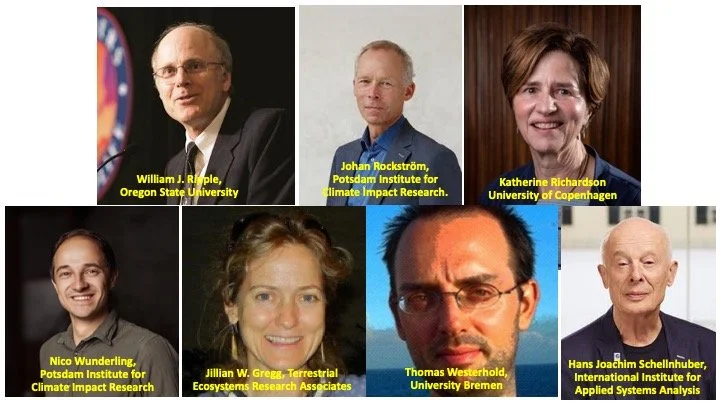
Figure 1. Contributing Authors. Working with Ripple on the analysis were Johan Rockström and Nico Wunderling of the Potsdam Institute for Climate Impact Research; Katherine Richardson of the University of Copenhagen; Jillian Gregg, Terrestrial Ecosystems Research Associates; Thomas Westerhold of the University of Bremen; and Hans Joachim Schellnhuber of the International Institute for Applied Systems Analysis. Not shown: Christopher Wolf, Terrestrial Ecosystems Research Associates.
1.Accelerating warming. First, about 50 percent of all the greenhouse gas (GHG) emissions have entered the atmosphere since 1990, one-third of it since 2005 (note 2). The warming rate has risen from roughly 0.05 degrees Celsius (°C) per decade in the mid-20th century to about 0.31°C per decade today, the authors report. Since there is a direct correlation between GHG emissions and global temperatures, the heat has increased also. Scientists refer to the rapid changes since 1950 as “The Great Acceleration” (note 3). For those who are following the rapid worsening of the planet’s habitability, the accelerating conditions shouldn’t be a surprise. The increase of emissions and temperatures corresponds with the globalized economy, increased air travel, a burgeoning system of international commerce, and the development of synthetic ammonia that has doubled the number of crops and helped increase the planetary population from five billion in 1987 to eight billion in 2023, a 60 percent increase. Each of these accomplishments contributes to more fossil fuel use, more GHG emissions, and subsequently higher temperatures.
If these conditions continue to accelerate, humanity may have less time than it believes to get the climate crisis under control.
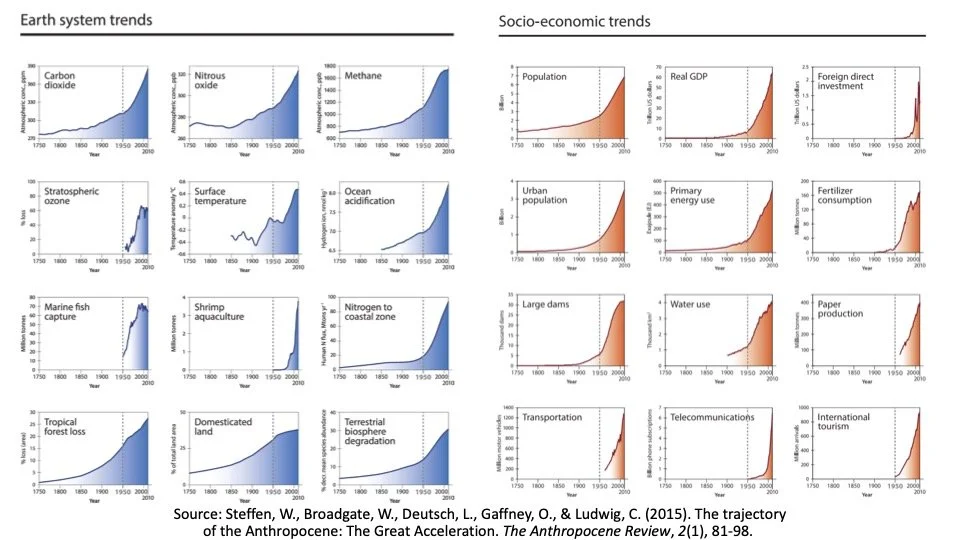
Figure 2. Earth system and socio-economic trends. Twelve Earth system and 12 socio-economic trends clearly show the jump in indicators that occurred around 1950, a phenomenon that became known as the Great Acceleration. Source: Steffen, W., Broadgate, W., Deutsch, L., Gaffney, O., & Ludwig, C. (2015). “The trajectory of the Anthropocene: The Great Acceleration.” The Anthropocene Review, 2(1), 81-98.
2. Global average temperatures exceed 1.5 degrees Celsius. Second, Ripple and his team report that the red line established at the Paris Climate Accord in December 2015 has been breached for 12 consecutive months. In Paris, scientists from the Intergovernmental Panel on climate Change (IPCC) alerted the public that an increase of global average temperatures by 1.5 degrees Celsius could herald dangerous meteorological and atmospheric conditions. The 1.5 degree red line was not supposed to be crossed until years from now. For instance, in October 2022, in its latest assessment report, the IPCC warned that the planet was on track to cross the 1.5 degrees Celsius by 2030 (note 4). However, record-breaking conditions in 2023 and 2024 – temperatures that shattered scientific predictions – have shocked climatologists and increased planetary temperatures faster than climate models had anticipated (note 5).
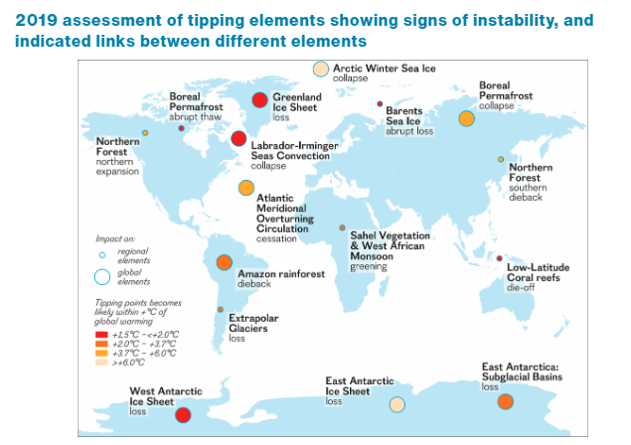
Figure 3. Tipping Points. Climate scholars have identified more than a dozen ecosystems that could face positive feedback loops. The interaction of multiple tipping points could start a tipping cascade which scientists fear could trigger an irreversible warming process.
3. Hothouse Earth possible. The third takeaway is the most concerning. Ripple and his fellow authors warn that the worst possible scenario – a runaway greenhouse gas effect – may be imminent. They write, “we may be approaching a perilous threshold, with rapidly dwindling opportunities to prevent dangerous and unmanageable climate outcomes (p. 5).” This would likely be caused by tipping cascades in which individual ecosystems (see Figure 3) collapse, triggering the rapid worsening of another, which in turn accelerates the warming process and creates a domino effect. The combined interaction of the two tipping points causes a third system to collapse which then cascades into a fourth, and so on (note 6). If this occurs, temperatures could spiral out of control no matter what actions humanity takes to correct it, a point of no return for human civilization.
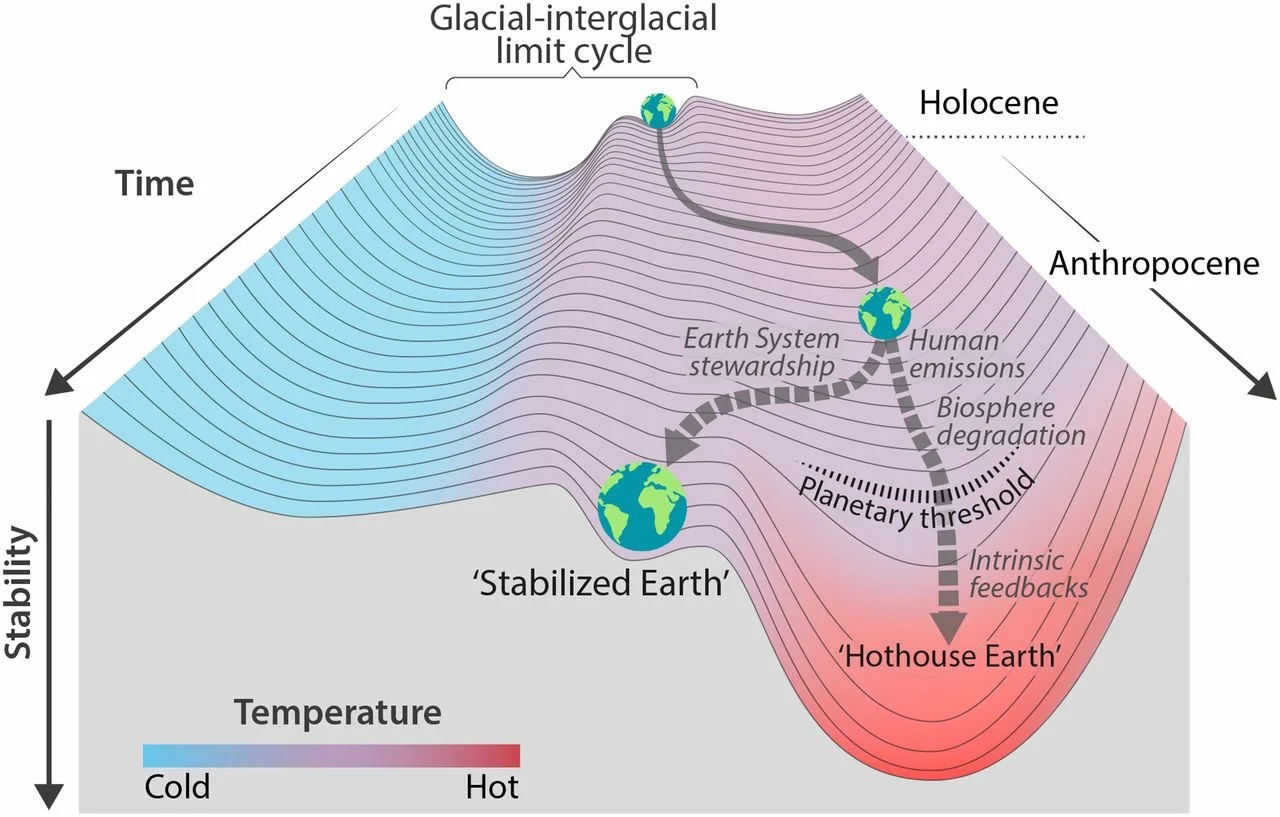
Figure 4. Hothouse Earth trajectory. Humans squandered multiple chances to correct the dangerous temperature increases on the planet. Unless corrective action is taken immediately, the species may reach a point of no return in which the planet crosses a threshold (prompted by tipping cascades) in which planetary temperatures spin out of control no matter what humans try to do. If that happens, the planet will heat to dangerous levels, effectively an extinction level event for humans. Graphic from the article, Will Steffen, et al, “Trajectories of the Earth System in the Anthropocene,” Proceedings of the National Academy of Sciences (PNAS), vol 115, no. 33, 14 August 2018.
Notes:
1. William Ripple is the distinguished professor of ecology in the College of Forestry at Oregon State University (OSU). His biography can be found here: https://directory.forestry.oregonstate.edu/people/ripple-william. Since 2019, he has led the scientific call for climate change action with the annual, “State of the Climate” reports. Readers can find the reports in the journal Bioscience: https://academic.oup.com/bioscience/article/75/12/1016/8303627 Perhaps also of interest may be Ripple’s 2019 report, "World Scientists’ Warning of a Climate Emergency,” also in the journal Bioscience: https://academic.oup.com/bioscience/article/70/1/8/5610806
2. United Nations Environment Programme (UNEP). Emissions Gap Report 2025: Off target – Continued collective inaction puts global temperature goal at risk [Olhoff, A., chief editor; Lamb, W.; Kuramochi, T.; Rogelj, J.; den Elzen, M.; Christensen, J.; Fransen, T.; Pathak, M.; Tong, D. (eds)]. Nairobi.
3. The term “Great Acceleration” was first introduced at the 2005 Dahlem Conference on the history of the human-environment relationship. See Will Steffen, et al, “The Trajectory of the Anthropocene: The Great Acceleration,” The Anthropocene Review, 2015; Will Steffen, Paul Crutzen, and John McNeill, “The Anthropocene: Are humans now overwhelming the great forces of nature?” Ambio, vol 36, no 8, December 2007.
4. According to the European Copernicus Climate Change Service (C3S), global average temperatures exceeded 1.5 degrees Celsius (above pre-industrial levels) for 14 consecutive months in October 2024. That year, 2024, was the hottest year in human history, a condition that broke the previous record set in 2023. However, because climate is a long term condition normally measured in multi-decadal changes, some scientists contend that a sustained rise in temperatures above that dangerous red line must last as long as 20 years to ascertain that the temperature increase is not an anomaly generated by conditions such as the El Niño Southern Oscillation (ENSO) or other temporary weather patterns. See Alex Cannon, “Twelve months at 1.5 degrees Celsius signals earlier than expected breach of Paris Agreement threshold,” Nature Climate Change, vol 15, March 2025, 266.
5. See Friedlingstein, P.: Global Carbon Budget 2025, Earth Syst. Sci. Data Discuss (draft version as of 02 Jan 2026).
6. Copernicus: Summer 2024 – Hottest on record globally and for Europe,” 06 September 2024. Link: https://www.copernicus.eu/en; World Meteorological Organization (WMO), “Global Annual to Decadal Climate Update 2025-2029,” 2025; Shannon Osaka, “Earth is likely to cross a key climate threshold in two years,” Washington Post, May 29, 2025.
7. Nico Wunderling, et al, “Climate tipping points interactions and cascades: a review,” Earth System Dynamics, vol 15, 2024, 44.