
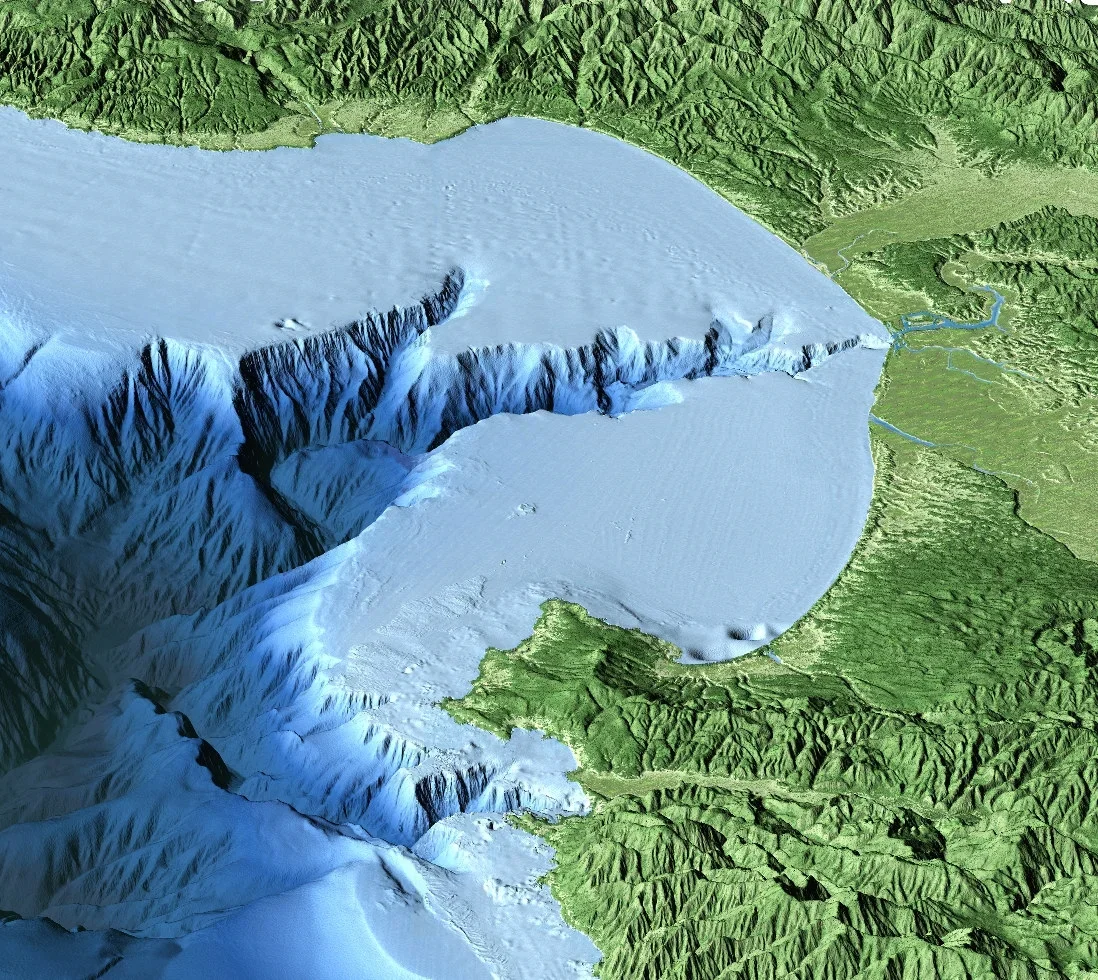
Caption: A surface and sub-surface topographical depiction of the Monterey Bay Canyon showing the extreme depths of the Monterey and Carmel Canyons, conditions that permit an upwelling of important nutrients that serve the interests of marine flora and fauna such as kelp, phytoplankton, and krill. Graph source: Monterey Bay Aquarium Research Institute (MBARI).
Monterey Bay Marine Sanctuary (MBMS) is a biodiversity treasure. One of 18 national marine sanctuaries, its marine flora and fauna have thrived for hundreds of thousands of years, withstanding periodic ice ages, changes to the ocean levels, and damage from human activities. As much an economic benefit as an ecological wonder, the Sanctuary draws millions of visitors to the Monterey Bay each year and provides a vital source of income for the half-million human inhabitants in Monterey County. (1) The state of California, Monterey County, and (for now) even the federal government have strict regulations in place to protect the area and devote significant resources to conserving its fragile conditions.
The Sanctuary is facing perhaps its greatest risk in modern history, not from overfishing, poaching, or pesticide contamination from nearby agricultural fields. Climate change is warming the planet's atmosphere and waters, creating conditions that threaten the Bay, its denizens, and the economic well-being of the communities that reside on its shores. Specifically, two recent developments may represent dangerous threats for the Bay: 1) a marine heat wave that formed off the Eastern Pacific Ocean in early 2026, and 2) a super El Niño that will form in the Eastern Pacific in the middle of the year. The effects on the Bay may be catastrophic.
This report focuses on the dangers faced by the Sanctuary due to the ongoing marine heat wave (MHW) and the imminent El Niño conditions. Specifically, the MBMS will suffer from 3 dangerous effects: 1) biodiversity loss, 2) increased acidity, and 3) decreased oxygen levels.
Marine heat waves
Like atmospheric heat waves, MHWs are different because they are often localized in a specific area and often last for months. (2) Because of human-generated climate change, the number of observed MHWs has doubled since 1982, and the duration of the warming trends in the oceans is expected to increase by 50 percent over that of the past century (3). The ocean absorbs about 90 percent of the heat in the atmosphere, serving as a massive heat sink (4). Warmer waters produce more storms because the increased temperatures permit more evaporation of the surface waters, providing more vapor and subsequently more precipitation from the storms. Research has shown that storms that pass over a marine heat wave are likely to increase wind speed by 36 percent more than storms that do not cross those areas (5).
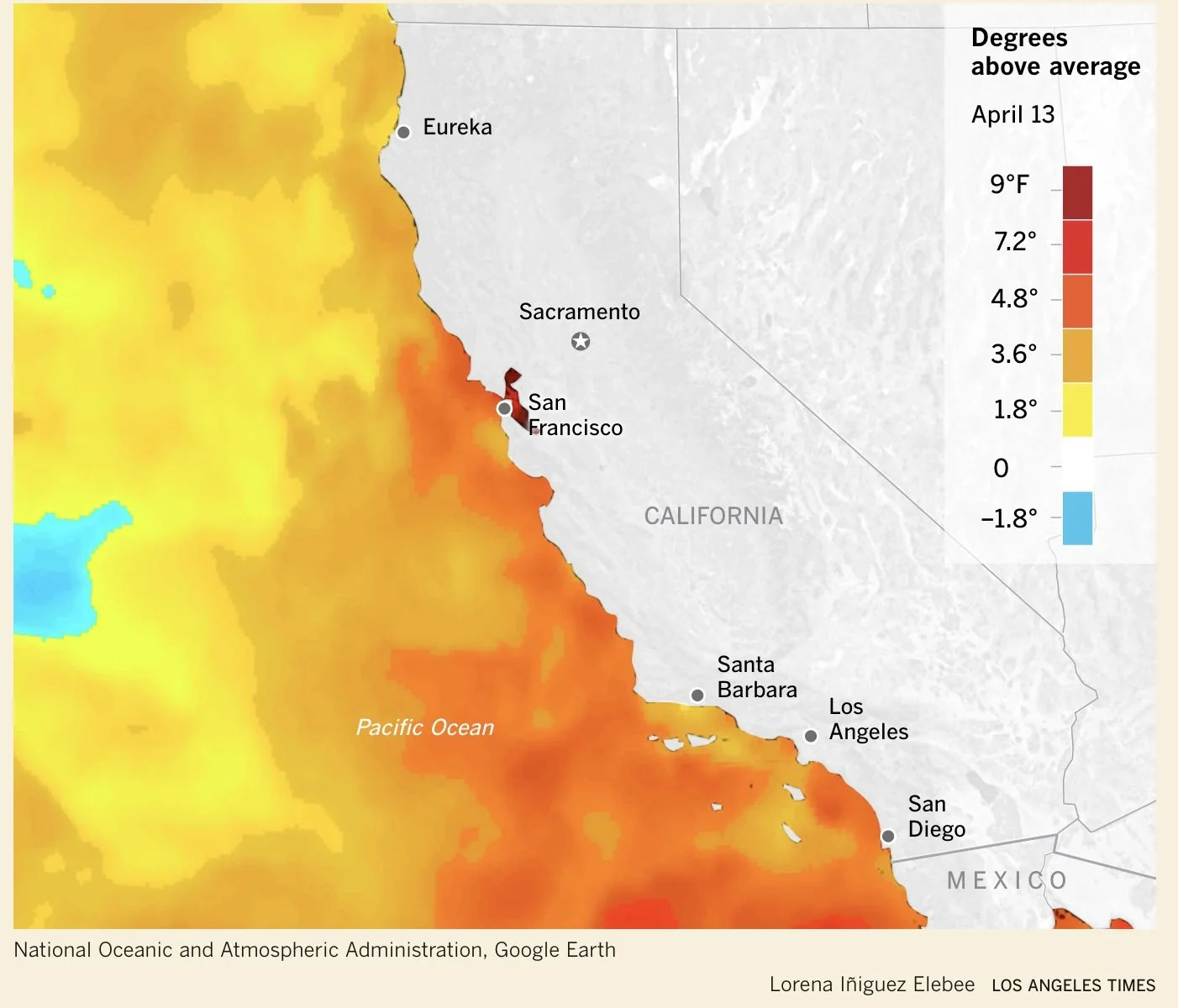
Caption: Unusually warm waters off the Southern California coast first appeared in February 2026. Graphic source: Hayley smith, “The Ocean off California keeps breaking heat records,” Los Angeles Times, 16 Apr 2026.
In early 2026, an enormous MHW formed in the Pacific Ocean. A product of global warming caused by human fossil fuel use, the MHW stretches 5,000 miles from the South Pacific to the California coast. Water temperatures off Southern California are 6-8 degrees Fahrenheit above normal, breaking records set over a century ago. Locally, in Pacific Grove, CA, local water temperatures broke records for 22 consecutive days (6). Warm water events such as the 2026 marine heat wave are referred to as “the blob”, an enormous body of above-average temperature water that spreads across the open ocean (7). Before it subsides, the current MHW may raise global average ocean temperatures by more than 2.0 degrees Celsius.
El Niño
The El Niño Southern Oscillation (ENSO) phenomenon – colloquially known as El Niño – is a regularly occurring change in wind patterns that can surge temperatures higher not only in the immediate vicinity but also across the planet. El Niño occurs every 2-7 years when prevailing winds in the Eastern Pacific blow from west to east, pushing warm tropical waters in the Polynesian Pacific toward Latin America. The warm conditions can last for 6-12 months. The term (“little boy” in Spanish) originated in Peru in the 1980s and refers to the arrival of the Christ child. Fishermen first noticed the warmer waters off the Pacific coast of South America around Christmas time. They are not new phenomena: El Niño and La Niña are part of the natural climate cycle of the planet and have been around for millennia, though El Niños are growing in intensity because of the increased concentrations of greenhouse gas emissions in the atmosphere.
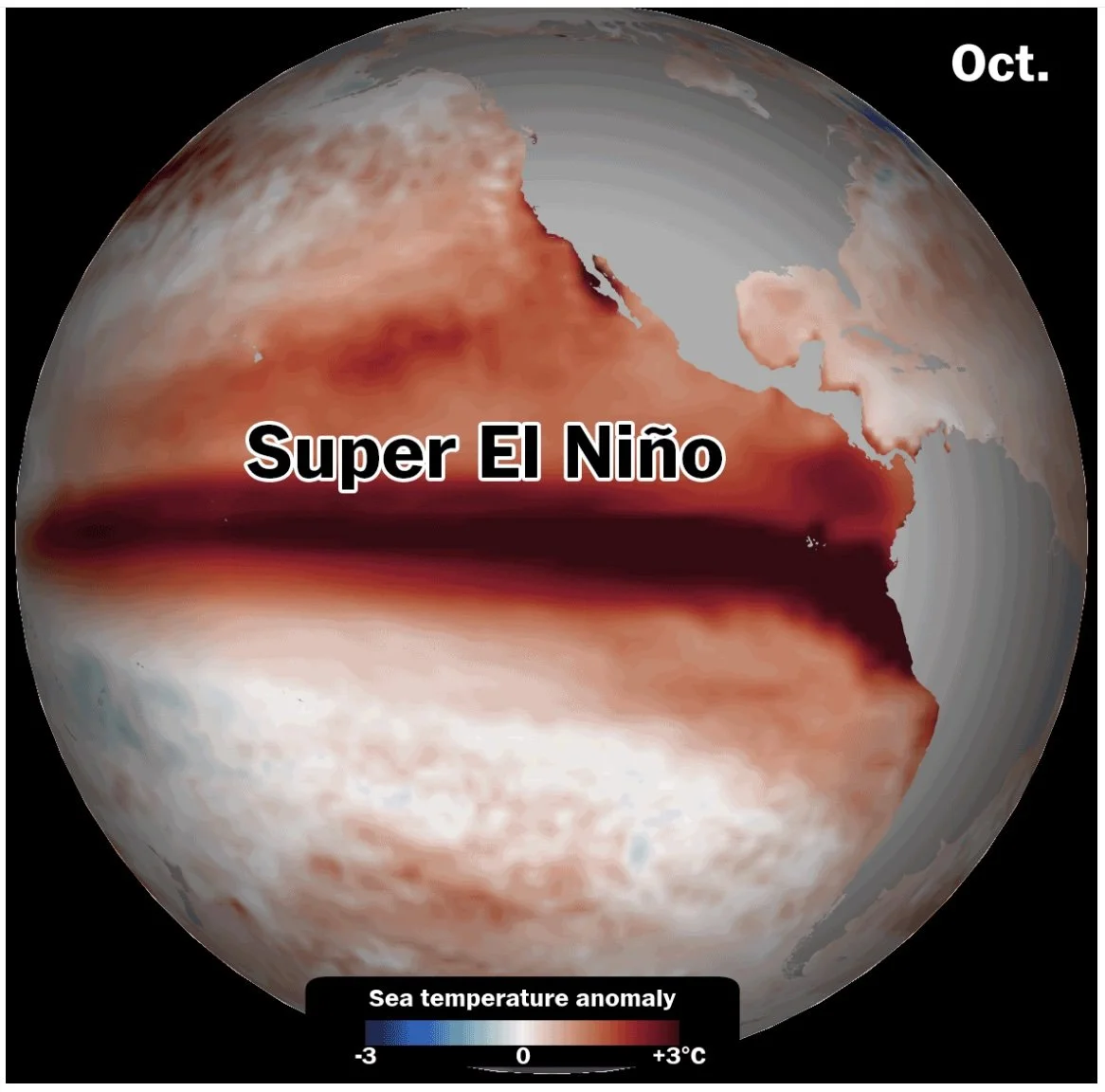
Caption: The map of the Eastern Pacific clearly shows the development of an El Niño in October 2026 as forecast by climatologists. Graph source: Ben Noll, “Why the odds keep rising for the strongest El Niño in a century,” Washington Post, 06 May 2026.
The El Niño predicted to begin in mid- to late-2026 may be the strongest in almost 160 years. It will have major consequences. One hopes that it is a short-lived El Niño, perhaps only 6-9 months. However, there is often a lag between the peak conditions of El Niño and the peak temperatures. Even if it begins to subside in early 2027, scientists estimate that 2027 could be the warmest year in modern history, beating the record-breaking temperatures experienced in 2024, till now the warmest year in human history (8).
It gets worse. A super El Niño could bump global average temperatures above 2.0 degrees Celsius, albeit temporarily. IPCC scientists consider 2.0 degrees Celsius a dangerous red line that, if passed, may cause catastrophic climate change disasters and trigger tipping cascades that lead to runaway greenhouse gas effects (9).
Impacts on the Sanctuary – loss of biodiversity
The one-two punch of dangerous hydrosphere temperatures from the marine heat wave, combined with a spike in atmospheric temperatures from El Niño, may be a knock-out combination. Marine heat waves can have serious effects on the health of other important components of the Bay’s fragile ecosystem, causing kelp forest degradation, dangerous algal blooms, and raising the level of acidification in the water (10).
The warmer waters can radically disrupt the delicate food chain. MHWs such as this one are deadly for marine animals who are accustomed to living in a narrow range of water temperatures. Because surface fish will go deeper to find cooler waters, sea birds such as pelicans, cormorants, and murres are being found starved to death on California beaches. Fishery degradation and sea lion starvation, for example, are common consequences. In 2016, for example, young sea lions starved because their primary source of food (fish) had disappeared.
Consider the plight of the massive sunflower starfish. These creatures – sometimes as large as four feet across – are voracious eaters of purple sea urchins. During the 2013-2014 marine heat wave, the warm ocean waters caused a mass die-off of the sunflower starfish from a wasting disease. Millions perished, almost a complete heat-induced genocide of every sunflower starfish in the Pacific Coast of North America. The disease outbreak, likely intensified by the warm ocean temperatures, decimated an estimated 80-100 percent of the sunflower starfish from this wasting condition across nearly 2,000 miles of the Pacific Coast along Mexico and the United States.
The eradication of the sunflower sea star had compounding consequences. Without their main predator, purple sea urchins multiplied rapidly, with populations increasing 60-fold. The urchins turned on their favorite food, bull kelp, decimating entire kelp forests along the North American coast. In Northern California, for example, an estimated 96 percent of the kelp has disappeared, devoured by the exploding population of voracious purple sea urchins. This has cascading effects because the disappearance of the kelp forests affects thousands of other species that rely upon the kelp forests for food, habitat, and shelter (11).
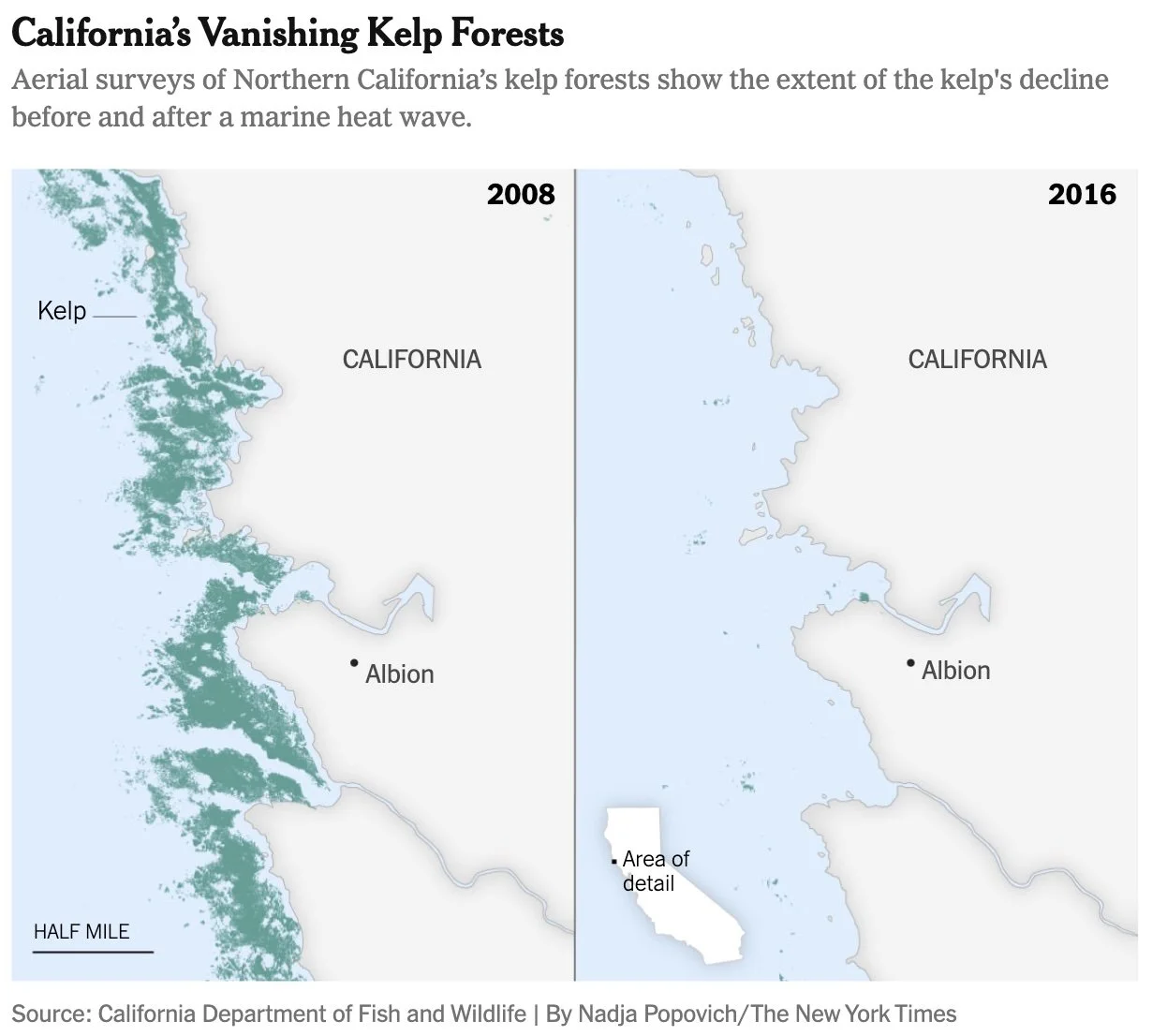
Caption: The loss of critical kelp forests along the Northern California coast is evident in this graph from the New York Times. As of 2026, ten years after the devastation, little of the kelp has returned. Graph source: Kendra Pierre-Louis, "California's underwater forests are being eaten by the 'cockroaches of the ocean.'" New York Times, 22 Oct 2018.
The mighty sunflower starfish was a victim of global warming caused by humans' insatiable thirst for fossil fuels. Sadly, they are not the first victim. Nor will it be the last. The 2021 Pacific Northwest heatwave, for example, took a massive toll on marine life, causing the death of an estimated one billion sea creatures (12). As this report goes to press, scientists struggle to reintroduce sunflower starfish to the Pacific Coast. They are raised in a handful of nurseries, one of which is in a small facility in Moss Landing. One wonders how many more marine heat waves the living creatures of the Bay can stand before portions of it become a dead zone.
Acidity levels in Monterey Bay
Ocean waters also absorb about 25 percent of the carbon in the atmosphere. When the carbon mixes with the salt water, it raises the acidity level. According to the Monterey Bay Aquarium, acidity levels in the Bay have risen by about 0.1 pH on the acidity/alkalinity scale (from 8.2 to 8.1 pH). That may not sound like much, but because of the logarithmic scale, it equates to about a 10 percent increase in acidity in the Bay, enough to create significant stress on the shellfish and corals in the Bay’s deep-sea coral reefs and cold-water coral communities. Shellfish such as clams, mussels, and oysters may not have strong enough shells to withstand attacks by predators.
Coral reefs – especially shallow reefs that are abundant in many tropical zones around the world – have suffered from the high water temperatures that increase acidification and destroy the reefs. High water temperatures cause coral bleaching. Within the tiny coral polyps is an alga called zooxanthellae. Coral and zooxanthellae coexist in a mutually beneficial symbiotic fashion. The coral houses the algae in its calcified protective cover and provides it with the carbon dioxide required for photosynthesis. In return, the zooxanthellae convert the CO2 into oxygen (O2) and provide the sugars and proteins that help the coral grow. However, when water temperatures are too high, the coral expels the algae from its tissue, resulting in a bleaching of the reef and a ghostly white appearance. Coral bleaching leaves the ecosystem without one of its most vital forms of nutrition and reproductive features.
Ocean water temperatures in 2024 averaged 1.63 degrees Celsius above the pre-industrial average, the warmest ocean temperatures in thousands of years (13). According to the IPCC, 70–90 percent of the coral reefs will sustain irreparable harm at 1.5 degrees Celsius of global warming. If temperatures reach 2.0 degrees Celsius, an estimated 99 percent will be destroyed, eliminating an essential marine ecosystem that will have compounding effects on other ocean life and on humans (14).
Source: ENSO Recent Evolution, Current Status and Predictions (NOAA, 11 May 2026), Link: https://www.cpc.ncep.noaa.gov/products/analysis_monitoring/lanina/enso_evolution-status-fcsts-web.pdf, accessed 14 May 2026.
Oxygen levels in the Bay
The Bay also plays an important role in the absorption of CO2 and production of O2, contributing to 50 percent of the O2 in the atmosphere generated by oceans. Kelp forests and plankton are important components of CO2 absorption. If kelp disappears, the ability to absorb CO2 is diminished. Terrestrial and sub-surface forests (such as kelp forests) serve as critical carbon sinks that absorb CO2 from the atmosphere and help slow the rapidly rising global temperatures.
Areas of low oxygen are harmful to marine animals and fish. The phenomenon, called hypoxia, is often caused by pesticides or fertilizers that spill into the bay from local waterways. The current MHW and ensuing El Niño will likely produce intense atmospheric rivers that will drop torrential rain in the Monterey Bay area. That precipitation, mixed with phosphorus and nitrogen-based fertilizers in the Salinas Valley and surrounding areas, will rush downstream into the bay. That, in turn, will create an algae bloom. The algae eventually die, sink to the bottom, and are consumed by bacteria. This creates an O2 deficiency, a dead zone devoid of fish and other marine life.
What does this mean for the Monterey Bay Marine Sanctuary?
Both of these weather phenomena – marine heat waves and El Niño – will have devastating effects on the MB Sanctuary. Marine biologists are calling the impact on the Sanctuary “devastating” and “extreme.”
For every individual and particularly for industry and business leaders, the best time to begin reducing greenhouse gas emissions from fossil fuel use was 25 years ago. The second-best time is today. It will take every single person in the Monterey Bay area doing their part to reduce their carbon footprint and to spread the word about the dangers climate change presents to the cherished Monterey Bay Marine Sanctuary. Start now!
References:
1. A 2023 study by the Monterey Bay Aquarium and Middlebury Institute of International Studies (MIIS) revealed that a single sea otter generates an estimated $5 million annually in direct and indirect economic impacts through ecotourism. Specifically in Elkhorn Slough, visitors drawn by the chance to see otters contribute roughly $3.2 million in direct spending and an additional $1.85 million in indirect gains. See Lisa Uttal, "Finding Sanctuary: how protection of marine sanctuaries benefits our local economy," Santa Cruz Sentinel, 18 Apr 2026.
2. The standard definition used by meteorologists is when abnormally warm water temperatures last for more than five days. Chelsea Harvey, “Ocean Heat Waves Are Getting Worse,” Scientific American, 11 April 2018.
3. Copernicus (EU), “Marine heat waves.” Link: https://marine.copernicus.eu/explainers/phenomena-threats/heatwaves?itid=lk_inline_enhanced-template (accessed 05 Jan 2025).
4. Lijing Cheng et al, "Ocean heat content in 2023," Nature Reviews: Earth and Environment, vol 5, April 2024; Peter Gleckler et al., "Industrial-era global ocean heat uptake doubles in recent decades," Nature Climate Change, vol 6, April 2016.
5. Choi, HY., Park, MS., Kim, HS. et al. “Marine heatwave events strengthen the intensity of tropical cyclones.” Commun Earth Environ 5, 69 (2024).
6. Paul Rogers, “Record ocean heat off California coast echoes ‘The Blob,’ killing seabirds and reshaping weather outlook,” Monterey Herald, 09 May 2026.
7. The term “the Blob” was first attributed to University of Washington scientist Nick Bond, a reference to a 1950s horror movie in which a large, gelatinous creature terrorizes a small town.
8. Ben Noll, “Why the odds keep rising for the strongest El Niño in a century,” Washington Post, 06 May 2026.
9. Ben Noll, “Why the odds keep rising for the strongest El Niño in a century,” Washington Post, 06 May 2026; Gabrielle Canon, “What is a ‘super El Niño’ and what might it mean for the global climate?” The Guardian, 24 Apr 2026.
10. Ben Noll, “What a 5,000-mile-long marine heat wave means for summer in the U.S.,” Washington Post, 22 April 2026; Hayley Smith, “The ocean off California keeps breaking records,” Los Angeles Times, 16 April 2026.
11. C. D. Harvell, D. Montecino-Latorre, J. M. Caldwell, J. M. Burt, K. Bosley, A. Keller, S. F. Heron, A. K. Salomon, L. Lee, O. Pontier, C. Pattengill-Semmens, J. K. Gaydos, “Disease epidemic and a marine heat wave are associated with the continental-scale collapse of a pivotal predator (Pycnopodia helianthoides).” Science Advances, 5, (2019); Kendra Pierre-Louis, “California’s Underwater Forests Are Being Eaten by the ‘Cockroaches of the Ocean’”, New York Times, 22 Oct 2018; Kendra Pierre-Louis, “Scientists Single Out a Suspect in Starfish Carnage: Warming Oceans,” New York Times, 30 Jan 2019.
12. Valerie Yurk & E&E News, “Pacific Northwest Heat Wave Killed More Than One Billion Sea Creatures,” Scientific American, July 15, 2021. Link: https://www.scientificamerican.com/article/pacific-northwest-heat-wave-killed-more-than-1-billion-sea-creatures/, accessed 10 Aug 2025.
13. EU’s Copernicus climatology center, “Streak of global records for surface air and ocean temperatures continues,” 06 June 2024. Link: https://climate.copernicus.eu/copernicus-may-2024-streak-global-records-surface-air-and-ocean-temperatures-continues
14. IPCC, 2023: Sections. In: Climate Change 2023: Synthesis Report. Contribution of Working Groups I, II, and III to the Sixth Assessment Report of the Intergovernmental Panel on Climate Change [Core Writing Team, H. Lee and J. Romero (eds.)]. IPCC, Geneva, Switzerland, section 3.1.2, p. 71. Source: ENSO Recent Evolution, Current Status and Predictions (NOAA, 11 May 2026), Link: https://www.cpc.ncep.noaa.gov/products/analysis_monitoring/lanina/enso_evolution-status-fcsts-web.pdf, accessed 14 May 2026.