
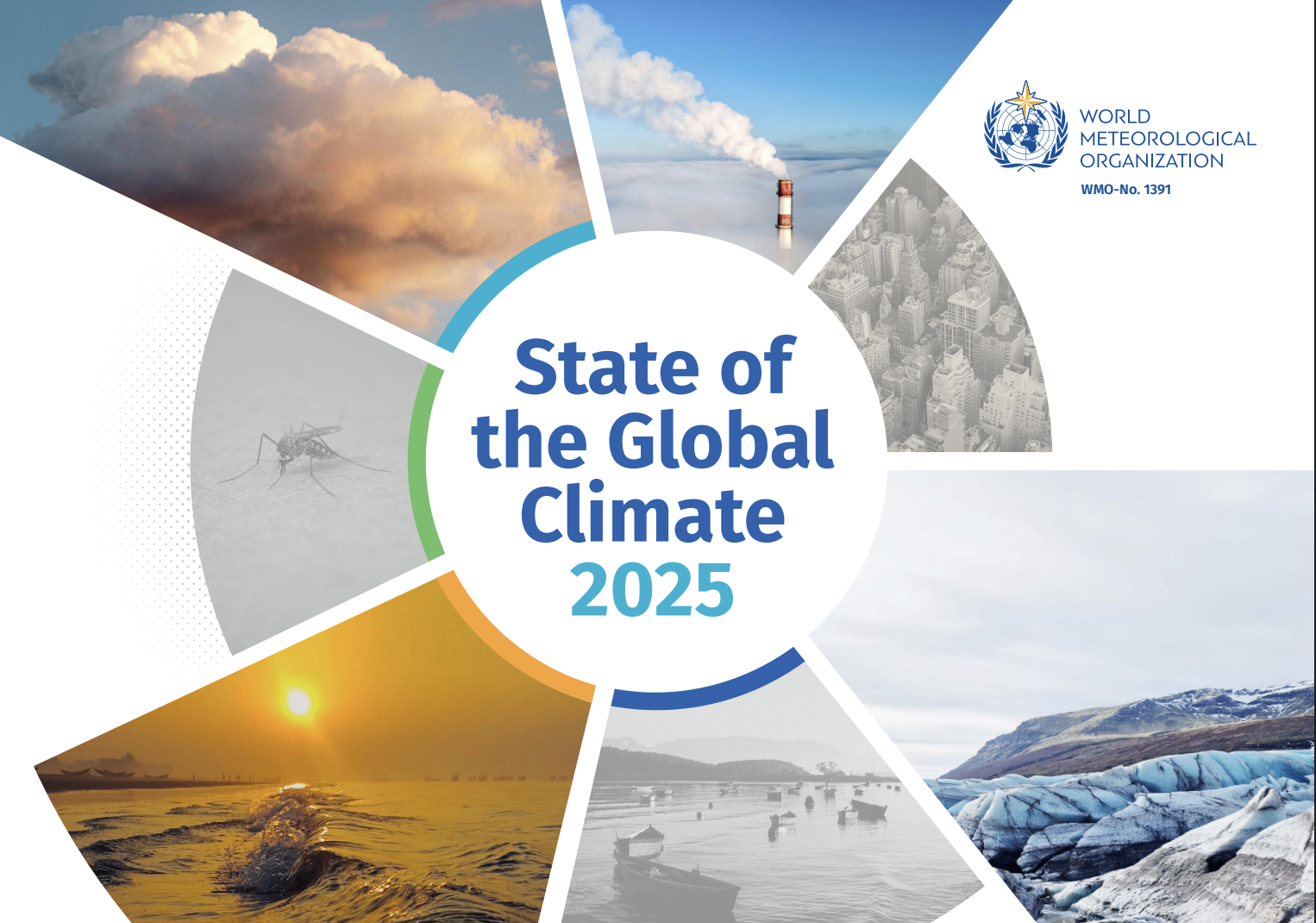
The World Meteorological Organization, 2026, recently published its annual report on climate change. The State of the Global Climate 2025 was released on March 23, 2026. And can be found here: https://library.wmo.int/idurl/4/69807
WMO Secretary-General, Celeste Saulo, wrote, “Let us ensure that Earth information is not only collected — but also understood, accessible, and actionable for all.”
In keeping with the wishes of the WMO Secretary-General, this short blog post will list the important highlights of the report. Summaries are slightly paraphrased for ease of readability.
· Increasing concentrations of greenhouse gases in the atmosphere reached their highest level in 800,000 years (p. 5).
· The year 2024 was the warmest year on record since modern temperature records were kept. The years 2023 and 2025 are the second or third warmest years (p. 5).
· The past eleven years, 2015-2025, were the eleven warmest years on record and the past three years, 2023–2025, were the three warmest (p. 9)
· The vast majority of heat produced by GHG emissions – around 91% – is absorbed by the oceans (p. 5).
· The atmospheric concentration of carbon dioxide (CO2) reached its highest level in the last 2 million years. Levels of methane (CH4) and nitrous oxide (N20) reached their highest levels in the last 800,000 years (p. 6).
· Ocean heat content has set a new record over the past nine years, each year surpassing the record temperature of the previous year (p. 10).
· So much heat has entered the oceans that it will require hundreds to thousands of years to reverse the trend (if emissions can be reduced). That means sea level rise is irreversible in human timescales (p. 11, 13).
· An estimated 29 percent of the CO2 emitted by human activities during the decade 2015–2024 was absorbed by the ocean, leading to an increased acidification of the oceans (p. 14).
· Eight of the ten most negative glacier mass losses since 1950 have occurred since 2016 (p. 5, 16)
· Ice loss from glaciers contributed around 21 percent of the total sea-level rise. Ocean warming contributed 42 percent of the total rise, and melting of the ice sheets in Greenland and Antarctica contributed 15 percent and 8 percent (p. 17).
· Glacier retreat since the 1950s, with almost all of the world's glaciers retreating synchronously, is unprecedented in at least the last 2,000 years (p. 17).
World Meteorological Organization (WMO). State of the Global Climate 2025. (WMO-No. 1342). Geneva, 2026. Link: https://library.wmo.int/idurl/4/69807