
3. Energy and power terms
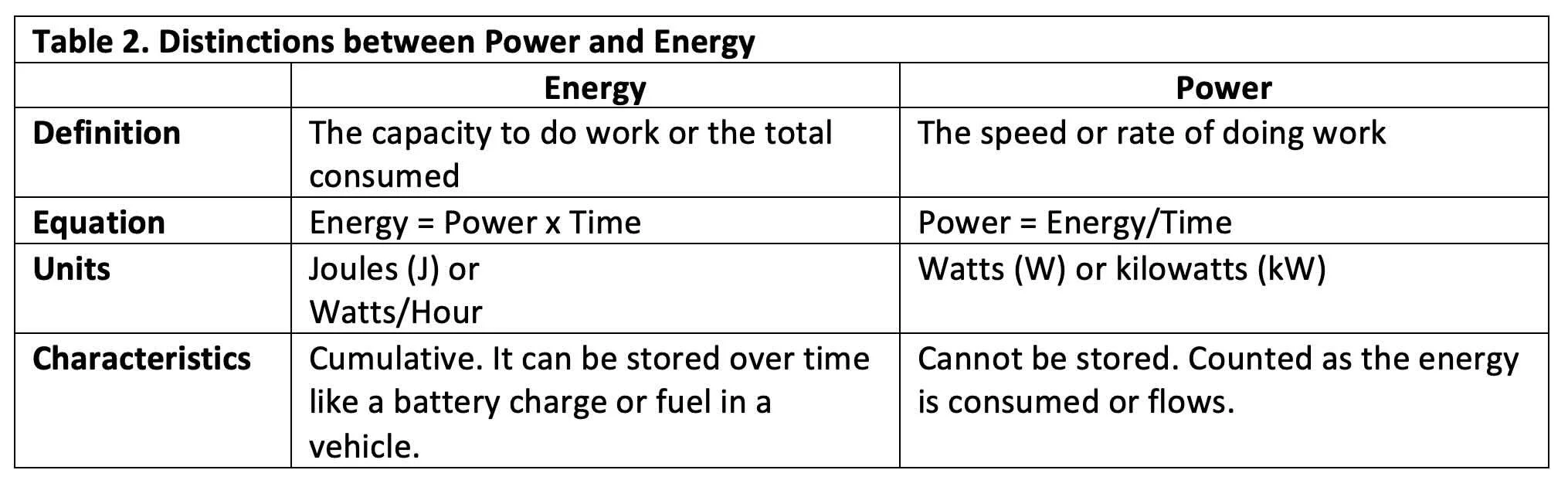
After the description of weights and GHG concentrations, let’s turn to more complex terms of power and energy. The two terms - power and energy - are often conflated but they are importantly distinct. Energy is the total capacity to do work, whereas power is the rate at which that energy is used. In other words, energy is power multiplied by time and is measured in Joules (J) or watts per hour. Power is energy divided by time and is measured in watts or kilowatts. (note 1). Simply put, energy is the total amount of fuel, and power is how fast you burn it. (2)
A common analogy is a water tank. The energy is the water and the power is the rate at which the water flows. A trickle of water is much less powerful than that of a high-pressure faucet. The watts are the power flow per second. So never say “watts per second,” just watts. The “per second” portion is already included in the definition of power.
Here’s another example, a surefire way to remember the difference between power and energy. It is one I found useful as I studied electrical engineering at the U.S. Naval Academy in Annapolis, MD, and on my first ship assignment as Boilers Officer of a 1200-pound steam warship. Those of us old enough to remember the old Star Trek series with William Shatner as Captain James T. Kirk and Leonard Nimoy as Spock will appreciate it. Their spaceship, the USS ENTERPRISE, was frequently in trouble, attempting to outrun a Klingon fleet or escape orbit before a planet was destroyed. The ship’s warp drive was powered by dilithium crystals and also provided power for the ship’s systems including its defensive shields and weapons. Captain Kirk’s chief engineer, Scotty, was in charge of the ship’s propulsion and electrical systems. On countless occasions, he was called upon to save the ship and crew from destruction.
Captain Kirk, during the tense moments, would call the engine room, “Scotty, we need more power!” Scotty would reply in his thick Scottish accent, “I’m giving you all she’s got, Captain!”
The lesson is that the Enterprise still had energy from its dilithium crystals. The lights were on, the communications worked, and the photon torpedoes were ready to fire. But what it did not have was adequate power to operate the energy-intensive warp drive.

Individual-level power requirements
Let’s try to put these energy and power terms into an understandable context by demonstrating how much energy and pollution are generated at varying levels of the emissions process. Electrical energy is normally provided through a power plant. An average-sized plant produces a couple of hundred megawatts, normally powered by coal and oil, although renewable power is providing more of this power as the transition to clean energy continues. As Bill Gates describes it in his 2020 book, when you hear kilowatt, think house. When someone says gigawatt, think of a city. And hundreds or more gigawatts are on a country-level. Tokyo, the most populated city in the world, requires 23 gigawatts of power. That number sometimes rises as high as 50 gigawatts during peak heat in the summer months. (3)
According to the Energy Information Administration (EIA), an average American home uses about 1.2 kilowatts (1,200 watts) per hour though that fluctuates depending on outside temperatures, use of appliances, the size of the house, and energy conservation practices of the individuals living in the residence. Some appliances, especially newer ones, are much more energy efficient than older models and several industries have adopted "Energy Star" standards to provide more efficient appliances that are environmentally considerate. (4)
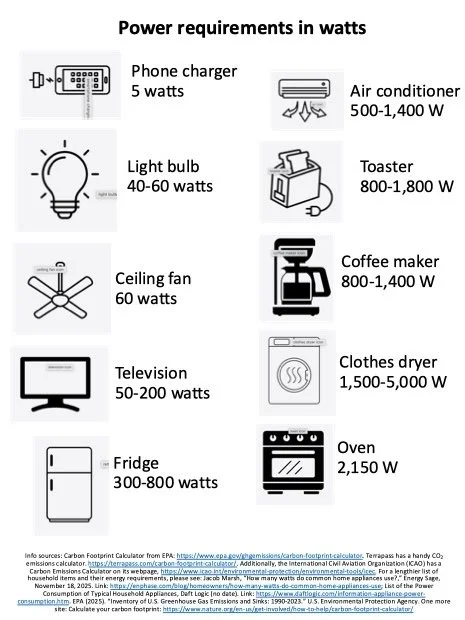
Within the home, a phone charger draws about five watts, a light bulb requires 40 to 60 Watts, a ceiling fan needs about 60 watts, a television may require 50-200 watts, and a refrigerator's power requirements are generally 300-800 watts. Even the "standby" light on an appliance that may indicate it is in "sleep" mode draws 1-2 watts. Appliances that produce heat normally require more than basic household items. An electric blanket requires 200 watts, a coffee maker needs 800-1,400 watts, and a toaster needs 800-1,800 watts. Larger appliances, particularly those that drive motors or produce heat such as a clothes dryer, require the most energy. A window air conditioning unit, for example, may require 500-1400 watts. An oven needs about 2,150 watts. A central air conditioning system normally needs 3,000 to 4,000 watts. A clothes dryer needs 1,500 to 5,000 watts. A jacuzzi draws 3,000-7,500 watts. (5)
4. Renewable energy amounts
The contemporary climate change crisis is a race against time. Nations must bring renewable energy systems online rapidly and wean themselves off fossil fuel systems. This must be done quickly before fossil fuel emissions raise the average planetary temperatures past tipping points and begin an irreversible acceleration of temperatures. The status quo is not an option, at least not if we want the human race to survive.
Within the United States, electricity demand is split evenly among residential, commercial, and industrial consumers, each requiring about one-third of the existing (2026) electricity generation capacity of the country. In 2023, total U.S. electricity generation was about 4.43 trillion kilowatthours, according to the U.S. Energy Information Administration. (6) The amount is rapidly increasing because of the demand for electricity from data centers.
For those reasons, we are in a race to develop new technology and deploy it worldwide on a commercial scale. Renewable energy systems are surging, but will it be fast enough? UK-based energy thinktank Ember reported that 647 gigawatts of new solar power systems and 167 gigawatts of new wind power systems came online in 2025 (814 GW total), an 11 percent and 47 percent increase from 2024. Total solar and wind power has reached 4,174 gigawatts. (7)
The previous paragraph only included wind and solar power, the two largest sources of renewable energy. However, several other types of clean, sustainable energy can also go into the calculation. Geothermal, hydroelectric, biofuels, and others contribute to the energy transition. For example, the Energy Information Administration (EIA) estimates that at least 1,000 gigawatts of renewable energy capacity needs to be added every year until 2030 to avoid crossing dangerous temperature thresholds. (8)
Here are some examples of the power capacities of other renewable energy systems. A hydroelectric power plant may produce billions of watts or gigawatts. For example, the world's largest dam, the Three Gorges Dam in China (completed in 2012), produces 22 Gigawatts each year. The Brazil Itaipu dam (completed in 2007) generates 14 GW. (9) The entire United States draws about 1,000 gigawatts on a daily basis. (10)
Nuclear reactors are also big producers of energy. According to the International Atomic Energy Agency, 416 nuclear power reactors are operating in 31 countries, with a total installed net generating capacity of 376 GW. That would be enough to power 376 small cities. (11)
Knowing the electricity capacity of these big sources of power is critical when we compare fossil fuel systems to renewable energy systems that must replace them. China, for example, is the nation that is the largest consumer of electricity, requiring 10,573 terawatt-hours (TWh), about one-third of the global total. The United States is second with 4,5036 TWh of electricity demand. India, Russia, and Japan round out the top five. (12) China leads the world in the amount of installed wind and solar power. The Asian giant added 300 GW of solar power and 100 GW of wind power in 2025 in new onshore and offshore wind projects, up from the record-breaking 80 GW in 2024. (13)
However, the good news was offset by China’s announcement that it had started building 94.5 gigawatts of new coal-fired capacity in 2024. (14) China uses more coal (about 56 percent of total use) than the rest of the world combined. In power ratings, China's coal use produced 92.2 exajoules in 2024. When combined with India, the amount of coal used by both countries is almost 70 percent of the global total. India's coal production generated 23.0 exajoules. (15)
One might also think of the electricity demand per capita. From that perspective, Canada is the top electricity consumer. On average, each Canadian requires 16.1 megawatts (MWh), the highest rate of any country in the world. The United States is second at 13.1 MWh. (16)
Conclusion
Thanks for reading this blog post. If you have examples of weights, concentrations, power, and energy systems that you’d like to share, please send them my way. And if I’ve misrepresented any of these abstract quantities, please let me know so I can make the description as precise as possible.
Notes:
(1) A watt is a Joule per second.
(2) Special Report on Renewable Energy Sources and Climate Change Mitigation - SRREN (11/2011).
(3) Bill Gates, How to avoid a Climate Disaster, New York: Vintage books, 57.
(4) ENERGY STAR is a U.S. government-backed system that certifies how energy-efficient appliances are. Appliances with a better-than-average performance and that meet the criteria in their category are labeled "ENERGY STAR certified."
(5) For a lengthier list of household items and their energy requirements, please see: Jacob Marsh, “How many watts do common home appliances use?,” Energy Sage, November 18, 2025. Link: https://enphase.com/blog/homeowners/how-many-watts-do-common-home-appliances-use; List of the Power Consumption of Typical Household Appliances, Daft Logic (no date). Link:
https://www.daftlogic.com/information-appliance-power-consumption.htm
(6) U.S. Energy Information Administration, “Electricity explained: Electricity in the United States,” Link: https://www.eia.gov/energyexplained/electricity/electricity-in-the-us.php, accessed 06 July 2026.
(7) Michelle Lewis, “The world added a record 814 GW of wind and solar – reshaping energy fast,” Electrek, 19 Mar 2026; Michelle Lewis, “EIA: New solar, wind, + storage capacity will swamp fossil fuels in 2026.” Electrek, 26 Mar 2026.
(8) Zia Weise and Chelsea Harvey, “The State of the Planet in 10 Numbers,” E&E News, 20 Nov 2023.
(9) Vaclav Smil, How the world really works (Viking, 2022), p. 36.
(10) Bill Gates, How to avoid a Climate Disaster, New York: Vintage books, 57.
(11) U.S. Energy Information Administration, “Five countries account for 71% of the world’s nuclear generation capacity,” August 11, 2025.
(12) Bruno Venditti, “Which countries use the most electricity?” Visual Capitalist, 12 May 2026.
(13) “Clean energy just put China’s CO2 emissions into reverse for the 1st time,” Clean Technica, 25 May 2025.
(14) Steve Hanley, “China plans to double renewable energy by 2035. That’s the good news.” Clean Technica, 17 April 2026.
(15) Jeff Desjardins, “Ranked: the World’s biggest coal consumers,” Visual Capitalist, 27 Apr 2026.
(16) Bruno Venditti, “Which countries use the most electricity?” Visual Capitalist, 12 May 2026.